
Announcement
Neptune Live: June, 2026
Neptune hosts its first live community broadcast: Neptune for tvOS is ready for the App Store, Neptune for iOS is submitted for TestFlight, and Neptune adopts a freemium model.

Neptune marked a first this month: a live, community-wide broadcast covering the state of the project and what comes next. It was a fantastic gathering of both new and familiar names, with an open-floor discussion that allowed for more direct communication regarding Neptune’s development. Here are some of the topics discussed during the event.
Neptune Live
The broadcast was hosted on Neptune Live, a brand new streaming platform built specifically for the Neptune community. Its goal is to provide a space where we can openly exchange ideas, share Neptune updates, and host future live presentations about the latest features. Sign-in happens via Discord, with additional authentication back-ends being developed for future sessions. The Discord login provides a quick and easy way for existing members to join sessions, retaining their existing server roles while also extending branding elements - like our beloved server emojis. The platform features both text and voice chatting, with an ‘Ask to Speak’ feature that grants hosts and moderators the ability to pass the microphone to individual speakers during discussions and Q/A sessions.
Neptune Live will continue to grow with new features already planned for the next event.
Hope to see you there!
Neptune for tvOS
Neptune first landed on tvOS via TestFlight back in January of 2026. Since its initial release, Neptune has gone from a rough public beta to something approaching a finished product - and it has done so largely in the open, with a community of almost 3,000 members watching, testing, and arguing over every build along the way.
The First Six Months
The most consequential work happened underneath the surface. A set of sweeping refactors, nicknamed the Blur Witch Project (a reference to one of our community members), tore apart and rebuilt Neptune’s networking, rendering, and caching layers. The heart of Neptune, Trident - its bespoke video engine - matured from an experiment into the app’s centerpiece, gaining direct play capabilities for nearly all audio and video formats, with the stability to be trusted for daily viewing.
On top of that foundation came a steady stream of features aimed at how people actually browse and watch their content. Personalization options allow users to modify nearly every facet of Neptune’s UI and user experience. Shortcuts allow users to pin almost anything - a show, a genre, even a specific timestamp in an episode - to their library. Person pages let viewers explore an individual’s full filmography. A rich tagging system surfaced tens of thousands of semantic tags, with an intelligent search engine and a slot machine for the indecisive.
Improvements weren’t just limited to the client. Neptune now ships with its own server-side Plugin Suite, with two plugins currently available: Indexers and Mobile Device Management. Indexers offload library and search indexing to the Jellyfin server, allowing every Neptune client to instantly update its local data with new content. The MDM features allow user settings to sync across every client in real time, grants server-side backups, and remote configuration tools that allow administrators the ability to remotely manage Neptune clients for all of their users and to override Neptune’s own default settings to design your very own out-of-box app experience.
These features, and so much more, have solidified Neptune’s place among media clients on tvOS - with the best yet to come.
App Store Release
From the beginning, the project set out four goals, and all four shaped what the app is today:
- A design language. A consistent visual identity across the entire app
- Trident. A custom video engine that can Direct Play anything you throw at it
- Seerr integration. Discovery and requests built natively into Neptune’s user experience
- Server Plugins. Migrating long-running work onto the server, keeping data consistent between clients, and provide remote management tools for administrators
With those four complete, Neptune for tvOS is now ready to release on the App Store. Expect more information about this to release in the coming weeks.
“Ready for the App Store doesn’t mean Neptune [tvOS] is finished. It means the app is mature enough to welcome a much larger audience. Things will only get more challenging from here, and I am ready to accept those challenges with open-arms.” — need4swede, Neptune Founder
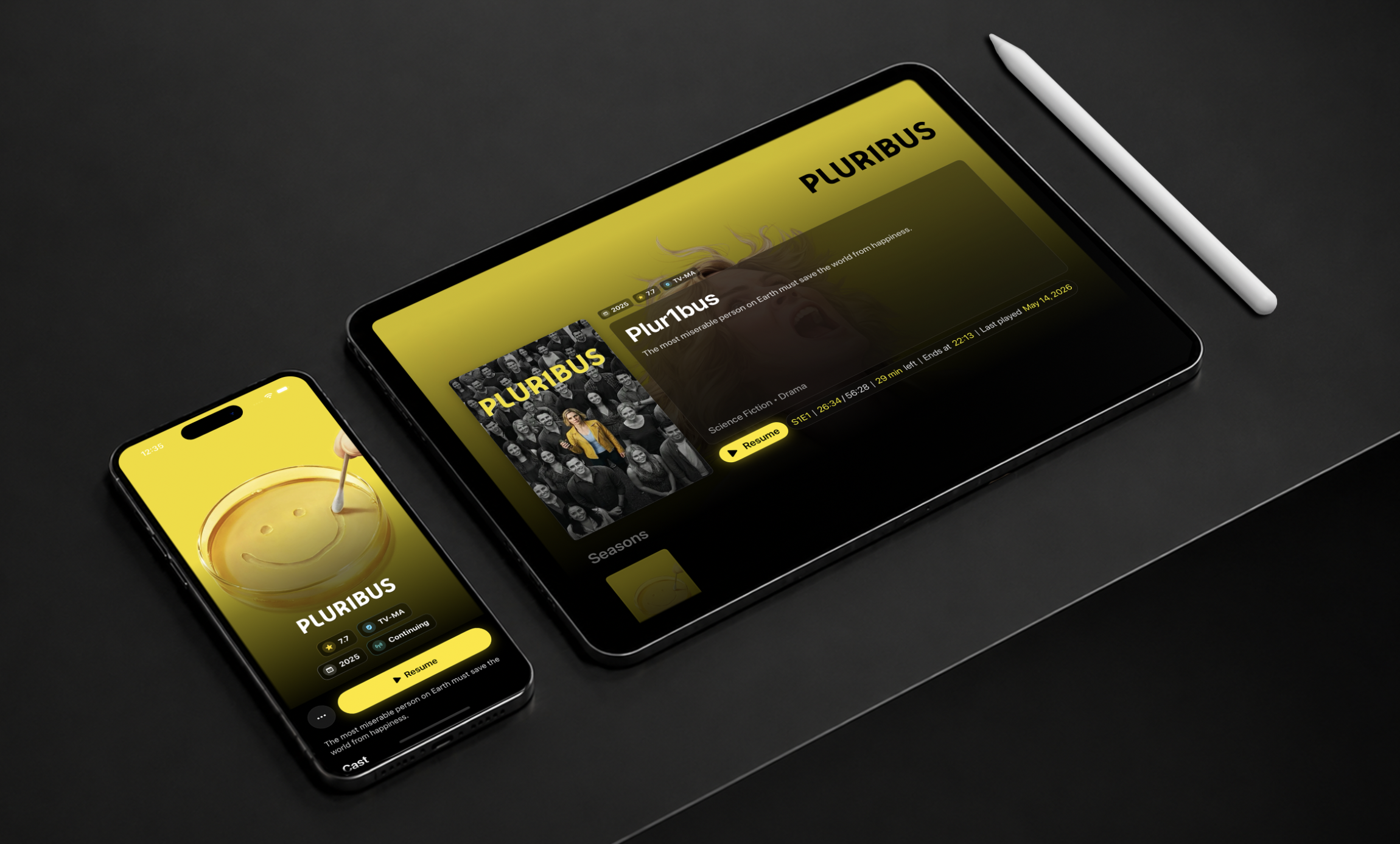
Neptune for iOS
Neptune for iOS was submitted to TestFlight shortly before the Neptune Live broadcast began and is expected to be available within the week.
Neptune for iOS is the same client you’re used to: the same features, the same interface language, and the same settings where they apply, including Trident for Direct Playback and the same debugging workflow underneath for troubleshooting. The differences are deliberate, and they follow the platform:
- A portrait-first layout. Rebuilt for vertical browsing rather than adapted from the living-room layout.
- Touch controls. Focus navigation gives way to direct manipulation, which opens room for new ideas, such as episode browsing using an iPod-style scroll wheel.
- Battery and thermals. On a mobile device, power draw and heat are real constraints. Both Neptune and Trident have been adapted to make the most out of your mobile device without draining your battery or causing it to overheat.
Once Neptune for iOS is live on TestFlight, an announcement will be made to notify all existing Neptune users. In the meantime, you can explore previews of Neptune for iOS in the community’s Showcase channel.
Pricing
Pricing has been a long-running discussion among Neptune users. In the interest of transparency, a dedicated Pricing channel was opened to hash out the topic with the broader community. As unconventional as it may be to invite everyone to pitch a pricing model, it stays on-brand with Neptune’s goal of keeping users part of the decision making process. Ideas were exchanged and polls were run to settle on the right target for release.
After much deliberation, Neptune’s base price will be free.
That covers the majority of its core features, with a freemium model layered around specific features, such as those that carry real, recurring costs, like licensing and API services. Neptune will offer the following pricing options for the premium features:
- Monthly: $1.99
- Yearly: $16.99
- Lifetime: $129.99
If the features that require licensing don’t apply to you, or if you’re not interested in the extra bells and whistles, then you can continue to enjoy Neptune’s base features at no cost - no ads, no data collection and no interruptions.
What’s Ahead
Bug fixes will continue to roll out as per usual. Additional backends are being explored, including Plex and Emby, expanding Neptune’s existing capabilities as a media client and cross-platform development will have more of a footprint within community discussions, as Neptune for iOS [with iPadOS landing shortly after] makes its way into user’s hands.
The next Neptune Live will be announced through our community channels, covering additional topics and features.